ACU's Mission and CST principles
As a Catholic university, we are guided by our mission, a strong sense of identity and firm set of values. All three influence the decisions we make as an institute of higher education and guide our staff and students in their day-to-day lives. The Mission acknowledges truth, academic excellence and service are our core values. The Mission is complemented by a set of values that guide our daily operations: equity, diversity, accessibility, wellbeing and sustainability. In sum, ACU believes in celebrating life, enriching experiences and solving complex problems by giving back to those in need. As part of ACUs mission we are committed to ensuring that all ACU students and staff have the opportunity to make a contribution to their community that is feasible and meaningful to them, and that meets community needs in a valuable and respectful way.
The following summary (adapted from Tohill, 2004), highlights the nine Catholic Social Thought (CST) principles used at ACU. These principles are distinctive of the Catholic tradition and have common traits and characteristics to other religious traditions, humanist approaches of moral and ethical behaviour, and human development.
| Dignity of the human person |
Innate personal value or rights which demands respect for all people, regardless of race, social class, wealth... |
| Common Good |
Sacrificing self interest to provide for the basic human needs of everyone makes the whole community flourish. |
| Preferential Option of the Poor |
When decisions are made by first considering the needs of the poor. |
| Subsidiarity |
When all those affected by a decision are involved in making it. |
| Universal Purpose of Goods |
The earth's resources serve every person's needs regardless of who 'owns' them. |
| Stewardship of Creation |
Duty to care for the earth as a (God-given) gift is a personal responsibility for the common good. |
| Promotion of Peace |
Everyone has the duty to respect and collaborate in personal relationships and at national and global levels. |
| Participation |
Everyone has the right and the duty to take part in the life of a society (economic, political, cultural, religious...). |
| Global solidarity |
A recognition that we are all interconnected, part of one human family. |
Source: Adapted from Tohill (2004)
Human dignity further explored
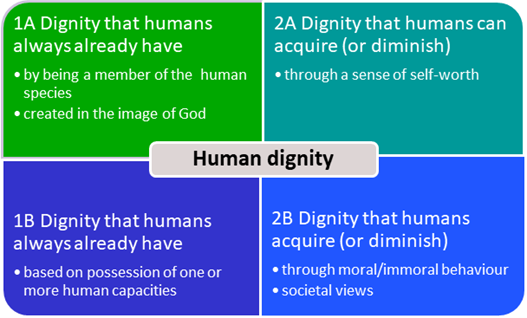
In his model (see below), Kirchhoffer (2013) suggests human dignity can be understood as something which we both already have, and something which we can acquire (or which can be diminished). From this multidimensional perspective, human dignity is something that encompasses our whole life and something to which we aspire as a human person. It has an individual and a collective component.
Kirchhoffer (2013) states:
"The fullness of human dignity is always more than what any one person can say about it, greater than any one definition of it, and beyond what even the most exemplary human life reveals it to be. (p.283)"